


The Atacama Gas Pipeline transports natural gas at high pressure.
SPECIFICATIONS
- Highly Flammable Gas (Main Hazard).
- Appearance: Odorless and colorless.
- Gaseous: Under normal conditions.
- Specific Gravity: 0.61 (Lighter Than Air).
- Caloric Value: 9300 Kcal/m3
- Lower flammability limit 5 % and higher flammability limit 15%.
COMPONENTS
- Methane: 90%
- Ethane: 6.38%
- Propane: 0.22%
The chemical symbol for Natural gas is CH4
- 1 Carbon Atom
- 4 Hydrogen Atoms
Preventive Measures undertaken by Gas Atacama
There is strict compliance with national and international guidelines and standards in the design and construction of the gas pipeline.
- Quality of the materials.
- X-ray inspection of 100% of the gas pipeline welding.
- Pipeline cathode protection system (prevents corrosion).
- Pipeline installation considering a minimum depth in accordance with population density.
- Stabilization measures and special works in natural hazard areas (landslides, fault crossing, rivers, etc.).
- Hydraulic testing exceeding the maximum operating pressure.
- Technical Inspection during construction and Project Certification by International Quality Control Companies.
During operation the system is monitored in its entirety, 24 hours per day, 365 days per year.
- SCADA satellite monitoring and communications system (remote control from Jujuy (Argentina) and Santiago (Chile).
- Gas pipeline and facility programming and maintenance procedures. Preventive maintenance.
- Study of Natural Hazards and Auditing Processes.
- 24 hour telephone watch.
Regular Controls
- Periodic inspection of the pipeline in order to assess the corrosion conditions.
- Cathode protection controls.
- Valve operation and maintenance controls.
- Water erosion controls.
- Clogging detection.
- Leak detection. Systematic right-of-way patrols are performed using high-precision calibrated equipment for early methane leak detection. Maintenance operations are optimized to minimize gas venting into the atmosphere. These measures are carried out in compliance with international standard ASME B31.8, corporate environmental standards, and gas quality specifications under NCh2264 in Chile and NAG-602 in Argentina.
- Step by step tour of the whole gas pipeline.
- Third party activity and human settlement control.
- Community broadcast.
- High Consequence Area (HCA) analysis is integrated into risk assessments, continuously monitoring population density and potential impact radiuses. In addition, a comprehensive infrastructure risk assessment is conducted every five years, with a tendering process currently underway for the new quinquennial study. All evaluations adhere strictly to the ASME B31.8S standard, Supreme Decree No. 280 in Chile, and NAG-100 regulations in Argentina.
- Investment priorities are focused on updating SCADA system hardware in control rooms to ensure monitoring reliability, as well as executing mechanical and geotechnical track integrity works in the Argentine section to protect the pipeline right-of-way. All projects are executed under ASME B31.8 and ASME B31.8S standards, subject to oversight by SEC in Chile and ENARGAS in Argentina.
- Continuous 24/7/365 remote monitoring and supervision are maintained in coordination between the control rooms in Santiago (Chile) and Jujuy (Argentina). Structured emergency response plans regulate critical event containment and crisis communication. Personnel readiness is validated through periodic drills in cooperation with fire departments, civil defense, and local authorities, complying with Supreme Decree No. 280 (Chile), NAG-100 (Argentina), and Ministry of Energy protocols.
Safety Strip Restrictions
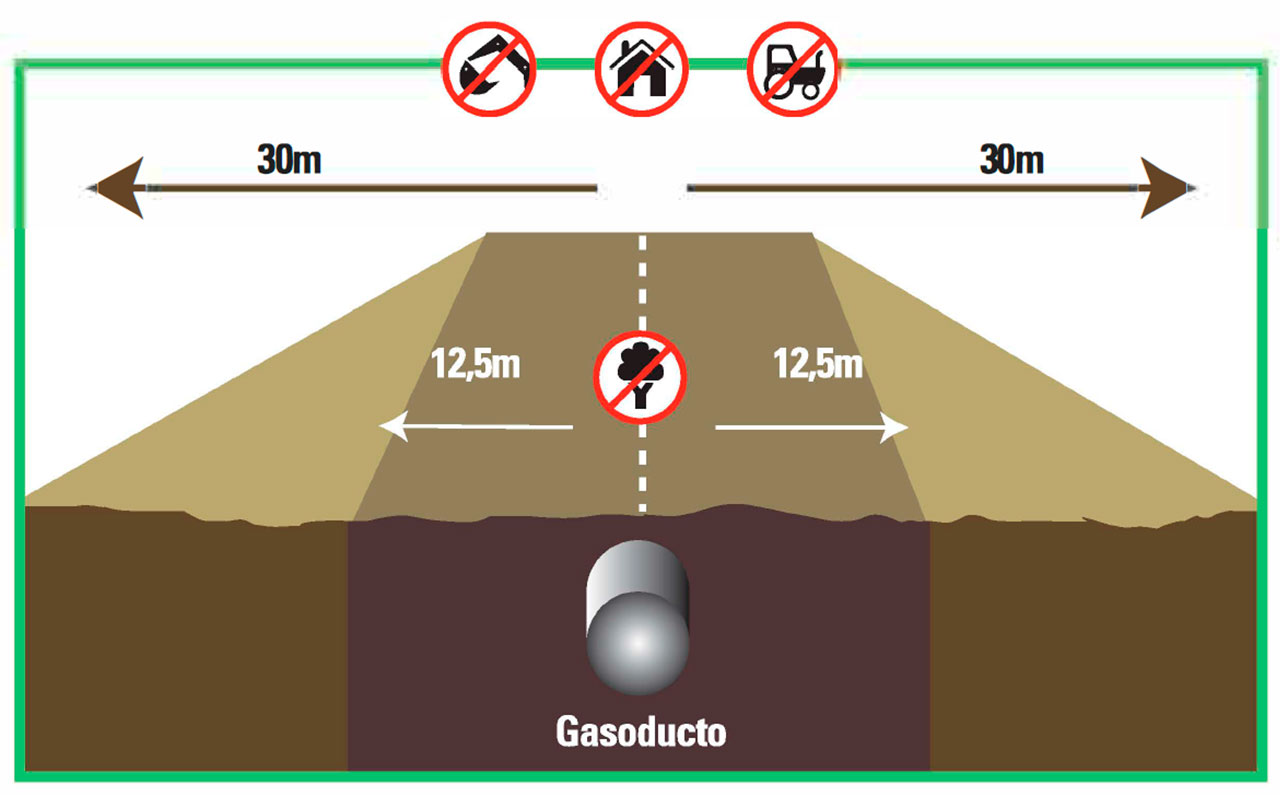
Prohibition of planting trees closer than 12.5 meters distance away from each side of the gas pipeline.
Prohibition of excavating, constructing, making fire, and transiting with heavy machinery less than 30 meters distance away from each side of the gas pipeline.
NOTE: The signs and markings are referential and do not necessarily indicate the exact location and depth of the gas pipeline.